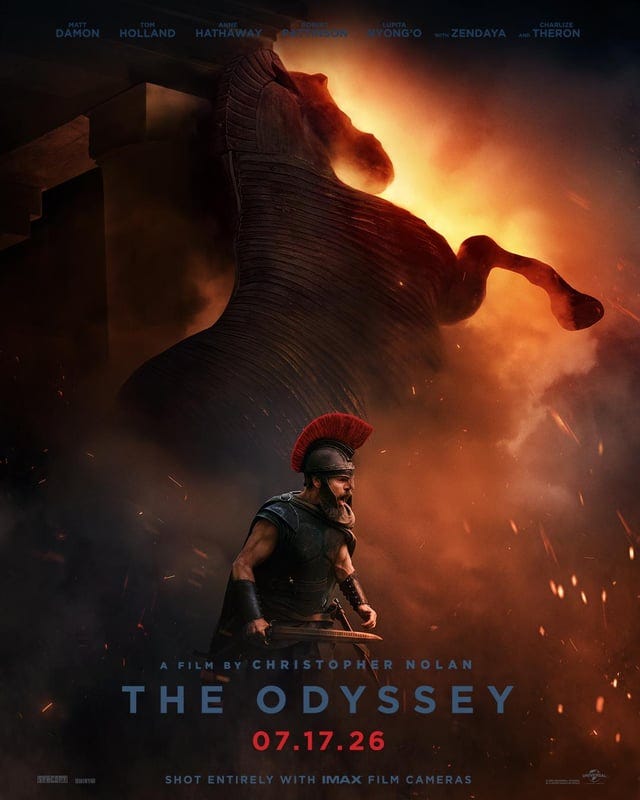
As much as I admire his craftsmanship, Christopher Nolan has always been extremely hit or miss with me. Thankfully, a dozen films and countless accolades into his career, I think he has finally created his best work.
The Odyssey is very much Nolan’s interpretation of Homer’s epic poem, but that is exactly as it should be. After all, the story itself has always existed as a retelling of Greek mythology, passed from one generation to the next and reshaped by each storyteller who takes it on. The attention to detail here is astonishing. The score was performed on period-appropriate instruments. The costumes are lush and handwoven. The lighting reflects how the world might have looked before artificial light. All of these ingredients work together to make the world feel vitally real and lived in.
Even the gods, so much at the forefront of Homer’s poem, take a backseat in Nolan’s telling. You hear their warnings. You witness their wrath. Yet despite Zendaya’s performance as Athena (and even that is left intriguingly ambiguous by the ending), their presence is more often felt than seen. It’s a welcome display of restraint from a director I have often found lacking in subtlety.
What’s phenomenal about Nolan’s interpretation isn’t merely the scale (although it is absolutely monumental). The film relies almost exclusively on practical effects, with CGI used sparingly to enhance what is already there. The Cyclops, for instance, began as a massive practical puppet, with digital effects used only to complete the illusion. The sets are actual locations, making production considerably more difficult but the results undeniably authentic.
The real draw, however, is the depth of the characters. Even with Nolan’s signature nonlinear storytelling once again front and center, it never feels like a gimmick. Instead, it serves the emotional journeys of figures many of us already know, whether we studied ancient history or are simply Greek mythology geeks like myself. There’s the spectacle of Odysseus’s long journey home to Ithaca and the intimacy of characters defined by longing, grief, and sacrifice. The film ultimately becomes an antiwar allegory that, in some respects, feels like a spiritual successor to Oppenheimer. Viewed back to back, Nolan’s last two films form a kind of cinematic revelation.
At three hours, I was almost certain there would be a moment where my attention drifted. Instead, I never once felt like I’d rather be anywhere else. Whether I was trapped with Calypso (Charlize Theron) in blissful forgetfulness on her island or surrounded by my crew-turned-pigs on Circe’s island (the horror sequences here are genuinely terrifying), I was completely along for the journey from beginning to end.
Matt Damon, Anne Hathaway, and Tom Holland bring extraordinary humanity to Odysseus and his family. And Robert Pattinson as Antinous once again proves he’s one of the best actors of his generation as a suitor with ulterior motives. Despite their celebrity, they disappear into these mythic figures, grounding the film’s epic scope in recognizably human emotions. I genuinely don’t think any of them have ever been better in a film of this scale.
With stunning cinematography, a magnificent score, and a remarkable ability to transform an often-inscrutable ancient poem into a deeply human story about returning home forever changed, The Odyssey is an epic masterpiece. I suspect it will remain part of the cinematic conversation for as long as Homer’s original tale continues to endure.
Rating: A